Showing posts with label beef. Show all posts

Monday, May 3, 2010

Grind Date: Bittman's Favorite Burger, Cold Asian Greens and Ginger Salad

IMG_0041

Mark Bittman's been talking about grinding your own meat for hamburgers since a 2007 Minimalist column. I'm just gonna let him explain:

The key is to avoid packaged ground meat. When you buy it, you may know the cut of the meat — chuck, for example — and the fat content.

But you have no way of knowing whether the meat came from high- or low-quality animals. It could come from dozens of animals, and they could all be poor-quality animals — old dairy cows, for instance, rather than cattle raised for beef. The meat from these animals is ground together in huge quantities.

If the aesthetics of that don’t give you pause, consider the health concerns. Massive batches of ground meat carry the highest risk of salmonella and E. coli contamination, and have caused many authorities to recommend cooking burgers to the well-done stage. Forgive my snobbishness, but well-done meat is dry and flavorless, which is why burgers should be rare, or at most medium rare.

The only sensible solution: Grind your own. You will know the cut, you can see the fat and you have some notion of its quality.

IMG_0101

Sold. I don't have a meat grinder, of course. But I do have a food processor, and you guys know how I love to use it. Score one more for the Cuisinart--it grinds meat!

Bittman suggests starting with a chuck roast or sirloin steak, cutting it into 1- or 2-inch cubes, and just pulsing it with a bit of onion. I did it in batches, not wanting to crowd the processor's bowl. I was careful not to chop too much, which Bittman warns against. Hindsight being 20/20, I definitely could have pulsed the meat a bit more, but it was still good. In this burger recipe, entitled simply My Favorite Burger, the only ingredients are the meat, about 2 lbs., half an onion, and salt and pepper. I added to that some soy sauce, but I figured on this inaugural DIY grinding project I'd just keep it simple.

The burgers were fantastic; you can really taste the quality of the meat. Bittman is right; it's going to be hard to go back to preground meat after this. The benefits far outweigh the perceived inconvenience which, really, only amounts to a few minutes of cutting, grinding and washing of the food processor. On top of that, you can use this method for any kind of burgers; pork, chicken, lamb, fish, whatever you like. Check out the Minimalist article, or HTCE, for more ideas.

IMG_0077

With the burgers, I made the Cold Asian Greens and Ginger Salad, which sounded great but ended up kind of mushy and weird. I may have just overcooked the bok choy, I'm not entirely sure, but either way I think I'd have preferred the Cold Cooked Greens, Greek Style which this recipe is a variation on.

The Minimalist: For the Love of a Good Burger [nytimes]
Thanks to Kyle Kabel for taking these pictures.

Friday, April 23, 2010

I Love You But You're Bringing Me Down: Beef Stew, Buttered Cabbage

I don't want to waste a lot of time or words on this one. I made it back in February when it was freezing and it was quite good, but not earth shatteringly delicious, and nowhere near as good as the Beef Daube.

IMG_9546


It photographed poorly and frankly, it's springtime now and I don't even want to think about braised meat until next year.

Served it with Buttered Cabbage, a pretty great vegetable dish that basically consists of butter, cabbage, salt and pepper. But again, it's such a wintery dish that looking at it now is bumming me out.

If anyone needs me, I'll be eating an enormous salad.

Wednesday, May 13, 2009

Low and Slow: Braised Anise-Scented Short Ribs

So, this recipe was one of the most full flavored, complex, rich and satisfying ones I have made so far. But overall, I think they're a little too fatty for my taste. I'd like to try the same recipe with a different cut of meat, maybe, because the combination of star anise, ginger, nam pla, carrots, potatoes, soy sauce, rice vinegar, and sugar did really magical things.

IMG_3175

This recipe is a variation on Short Ribs Braised with Mustard and Potatoes, and I wasn't sure if I was supposed to include the potatoes or not; I decided to use them after all because it seemed like it'd make the dish more substantial, so why not? It didn't say to omit them outright, but the variation does sort of just ignore them. I was glad I included them, but I'm still not sure if I was supposed to.

IMG_3172

Served it with the Roasted Red Pepper Vinaigrette from before.

Sunday, April 12, 2009

Win Some, Lose Some: Braised Beef Brisket

Not everything I did this Passover was an epic failure. No, this year I also made something I never thought I could handle: the brisket.

Brisket 4.jpg


Not just brisket, but the brisket. The lynchpin of the post-seder meal, a recipe that your grandma's probably been perfecting since before your parents were born. It's a lot of pressure, but I was confident I could do it after reading Alice Waters' "Slow Food" essay in Da Capo's Best Food Writing 2008 (I believe the esssay also appears in her Art of Simple Food book). "Nothing creates a sense of well-being like a barely simmering braise or stew cooking quietly on the stove or in the oven," Waters writes. I called Aunt Susan to see if I would be trusted with the task--after all, I'd have to make this recipe for the project eventually, right?

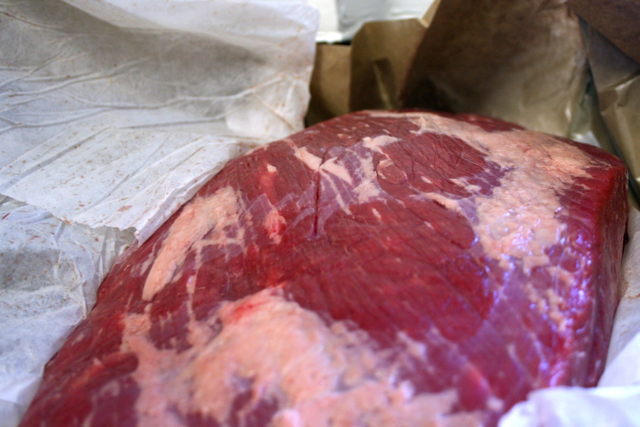
It wasn't until she said yes that it really hit me: I was making the brisket. Gefilte fish, that's manageable, no one likes that stuff anyway. Worst comes to worst we eat from the jar. But the brisket cannot be messed with. Then again, there's something fun about having a slab of meat (there were actually two of these) this huge in your kitchen:

Brisket 1.jpg


The most important thing, from what I'm told, is to find a good cut of brisket, where "good" means fatty. Anyway, Bittman's recipe in How to Cook Everything is, of course, pretty simple. Takes about three hours to cook, but there's not a whole lot going on, and barely even any prep work. I added carrots where he says just onions, but other than that I followed it pretty much exactly, and it came out great.

Brisket 2.jpg


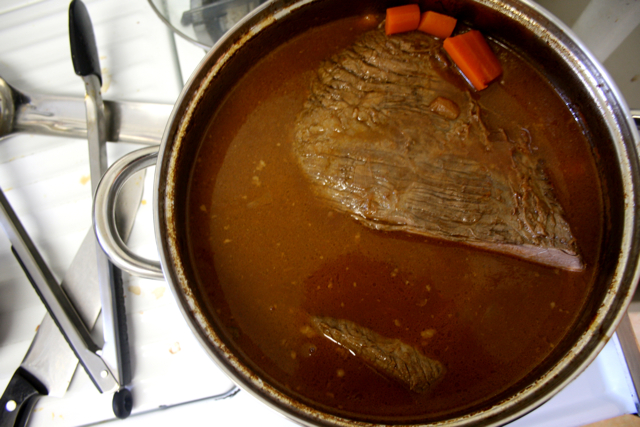
You brown the meat on both sides. Then you pour off the fat, and throw in the onions (and carrots, in my case). Let those soften and then throw in some minced garlic and tomato paste.

Brisket 3.jpg


Stir, return the meat to the pan, and then add stock, to almost cover the meat. Cover, stick it in the oven (300 degrees) and let it go for about 2 1/2 hours, turning it over every 30 minutes or so.

Brisket 5.jpg


And it works. The slow cooking really breaks down the connective tissue and fat in the meat and makes it really tender as it cooks. It's a bit disconcerting, because the meat definitely got really tough about 90 minutes into cooking, but then it came back around to tenderness by the three hour mark (it took more than 2 1/2 hours).

Brisket 6.jpg


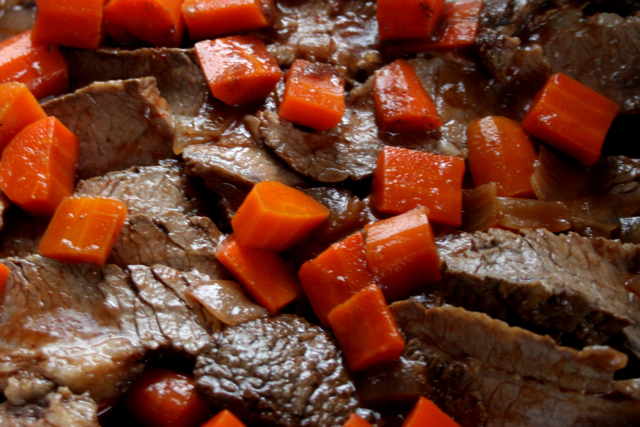
I let it rest, sliced it, and it was ready to go. Everyone at the seder seemed to enjoy it (I swear even my vegetarian cousins were eating the stuff), and I must say that it was even better as leftovers. A few days sitting in its own gravy works wonders, truly.

Wednesday, February 4, 2009

An Excuse to Use Slab Bacon: Beef Daube

Fact: Any recipe that starts by browning slab bacon is going to end well. It's science.

As far as I can tell, I've made seven meals, not sure how many recipes (I should really get a spreadsheet going), but still not a single dish with red meat. I had a feeling this might happen; I am a chicken man and have been for as long as I can remember. Well, after a sale at the store left me with 2 lbs. of boneless chuck roast, I decided it was time. Weather was cold, to say the least, and so I decided a stew of some sort was the way to go. Enter HTCE's Beef Daube, what Bittman says is a Provencal style stew.

So, you start by browning the chopped-up slab bacon (are there two more beautiful words in the English language?) until the fat is rendered and its pretty crispy. Then you remove it, trying not to munch it all up while it sits on the countertop. Brown the beef (cut into chunks) in the bacon fat. Then you remove the beef, set that aside as well, and throw in diced onions, carrots, celery, smashed garlic, rosemary, thyme, and orange peel. I didn't have celery because Fairway in Red Hook did me dirty, and I didn't have thyme, but this wasn't the end of the world; I just upped the carrot/onion and rosemary proportions a bit and carried on. So you sautee those veggies and aromatics (it's gonna smell really REALLY good) 'til they soften and then add a bit of red wine vinegar and a cup or so of red wine, bring it to a boil, put the beef back in, lower the heat and cover it.


Let that go for an hour or so, then throw the bacon back in. At this point, if its drying out, add a little chicken stock or just water. Give it another 15 or so or turn off the heat (it reheats really well) and finish it before serving.

Beef Daube turns out to be exactly what I was looking for. Served over some egg noodles, it was filling, soothing, warming, a delectable Sunday dinner. Time consuming, yes, but super easy. The hardest part was chopping up the veggies. I think my favorite part was that the flavors didn't exactly melt together; they went well, of course, but there was the distinct flavor of orange peel, rosemary, onion, bacon, each waiting to be picked out by the observant eater.


Chicken: who needs it?