Showing posts with label onions. Show all posts

Thursday, March 11, 2010

Brunch Dish: Spanish Tortilla

It's big, filling, cheap, and you can cook the whole damn thing at once: Spanish Tortilla is the best thing to make if you have some friends coming over for brunch.

IMG_8204

The Spanish Tortilla recipe in How to Cook Everything is basically a big pile of potatoes, eggs and onions cooked together in one pan. You sauté some onions and thinly sliced potatoes until soft in a large skillet (it helps a lot if it's nonstick). The potatoes and onions cook together in a whole bunch of olive oil--one cup. It's a lot, but you drain it out before adding the eggs. After draining the oil, 6-8 eggs go in a bowl with the potato-onion mixture, and that goes back into the pan (add some of the oil that was drained before you add the potato-egg mixture to the pan. You just cook this over medium heat until the edges firm up. Then, using a spatula to loosen the tortilla from the pan, transfer it to a large plate, turn it upside down using another plate, and finally return it to the pan, thereby flipping the tortilla. Cook it for another five minutes or so, and it's done. This thing is damn tasty, and it can be served warm or room temperature. I want some right now.

Wednesday, April 22, 2009

Pizza Party: Pizza Dough, White Pizza with Caramelized Onions and Vinegar, & Pizza with Tomato Sauce and Mozzarella

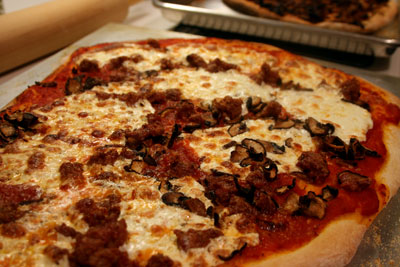
So, my mom's been wanting to make pizza for a long time now. The project seemed the perfect excuse, not that you need one: all things considered, it's a simple process and it yields great results even if you don't have a pizza stone, which *gasp* we do not. And it's really fun. And you can't argue with this:

Pizza.jpg

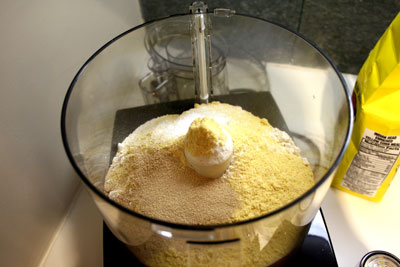
So you take flour, cornmeal (optional, but makes the crust crispier), yeast, and salt, and put them in the food processor.

Pizza3.jpg

Turn it on, and add some water and olive oil through the feed tube. It will form a ball within about thirty seconds; if it doesn't add some more water. What you end up with looks like this:

Pizza5.jpg

Put it on the floured counter. Knead it a little bit.

Pizza6.jpg

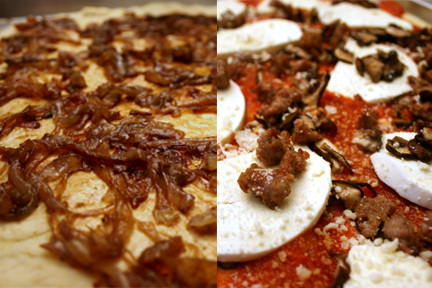
Put it in a bowl, cover it, and let it rise for 1-2 hours. Sounds like a lot of downtime, but this is when we threw together our toppings. Each batch of dough makes two pizzas (or one huge one, I guess). On one we did just some caramelized onions and balsamic vinegar. The other, tomato sauce, mozzarella, mushrooms and turkey sausage (from DiPaola Farms at the Greenmarket--the best turkey sausage I've ever tasted). So, we caramelized some onions, over fairly low heat, for a pretty long time til they were nice and brown and sweet and delicious. Did pretty much the same thing with the mushrooms, which cooked faster. Browned the sausage (crumbled out of its casing), and threw together a batch of Fast Tomato Sauce.

Pizza-Toppings.jpg

And by then, the pizza dough was ready.

We stretched and rolled it out so it was as thin as we could get it, then laid it out on the baking sheets and got to topping. For the white pie we mixed a bit of the balsamic vinegar with the onions and just spread them out on top. For the other pie, I spread out a pretty thin layer of sauce, then the cheese slices, then scattered about the sausage and mushrooms. Sprinkled some grated parmesan on top of that, because why not, and our pies were good to go.

Pizza8.jpg

Bittman says that they need to bake for 6-12 minutes on 500 degrees. Ours took more like 20 minutes, but maybe that's because we like a nice crispy crust. Here's the finished white pie:

Pizza2.jpg

This one is definitely going into heavy rotation; let me know if you ever want to have a pizza party and I'm so there.

Sunday, April 12, 2009

Win Some, Lose Some: Braised Beef Brisket

Not everything I did this Passover was an epic failure. No, this year I also made something I never thought I could handle: the brisket.

Brisket 4.jpg


Not just brisket, but the brisket. The lynchpin of the post-seder meal, a recipe that your grandma's probably been perfecting since before your parents were born. It's a lot of pressure, but I was confident I could do it after reading Alice Waters' "Slow Food" essay in Da Capo's Best Food Writing 2008 (I believe the esssay also appears in her Art of Simple Food book). "Nothing creates a sense of well-being like a barely simmering braise or stew cooking quietly on the stove or in the oven," Waters writes. I called Aunt Susan to see if I would be trusted with the task--after all, I'd have to make this recipe for the project eventually, right?

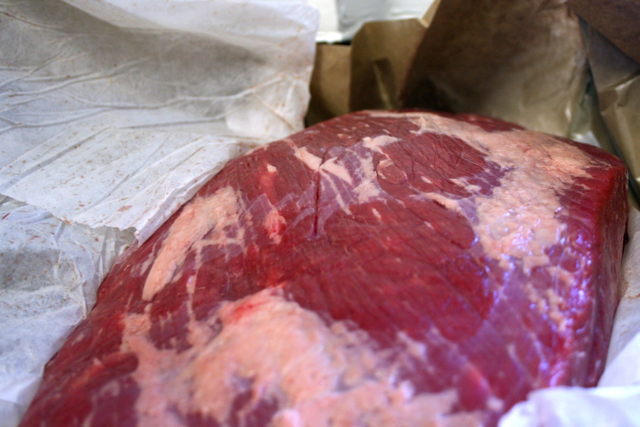
It wasn't until she said yes that it really hit me: I was making the brisket. Gefilte fish, that's manageable, no one likes that stuff anyway. Worst comes to worst we eat from the jar. But the brisket cannot be messed with. Then again, there's something fun about having a slab of meat (there were actually two of these) this huge in your kitchen:

Brisket 1.jpg


The most important thing, from what I'm told, is to find a good cut of brisket, where "good" means fatty. Anyway, Bittman's recipe in How to Cook Everything is, of course, pretty simple. Takes about three hours to cook, but there's not a whole lot going on, and barely even any prep work. I added carrots where he says just onions, but other than that I followed it pretty much exactly, and it came out great.

Brisket 2.jpg


You brown the meat on both sides. Then you pour off the fat, and throw in the onions (and carrots, in my case). Let those soften and then throw in some minced garlic and tomato paste.

Brisket 3.jpg


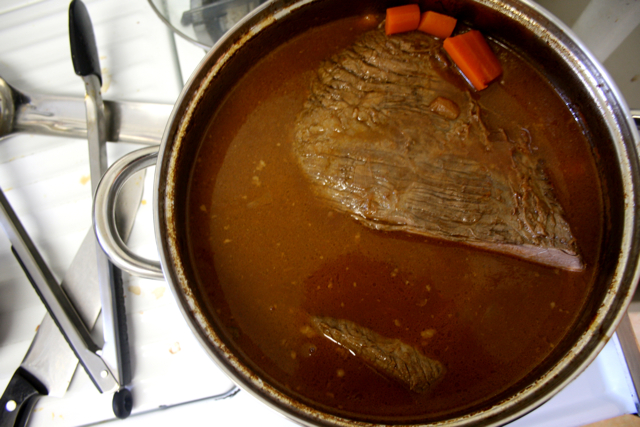
Stir, return the meat to the pan, and then add stock, to almost cover the meat. Cover, stick it in the oven (300 degrees) and let it go for about 2 1/2 hours, turning it over every 30 minutes or so.

Brisket 5.jpg


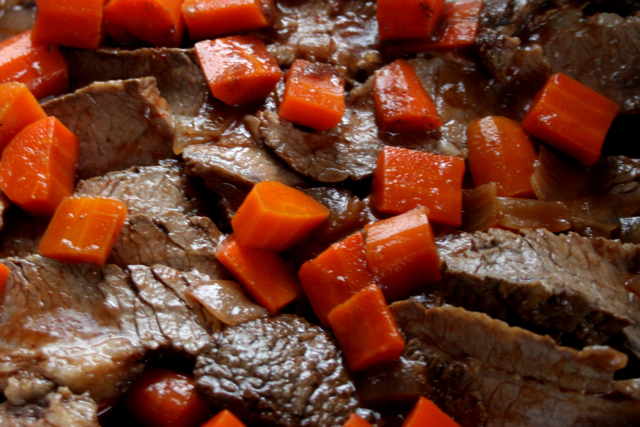
And it works. The slow cooking really breaks down the connective tissue and fat in the meat and makes it really tender as it cooks. It's a bit disconcerting, because the meat definitely got really tough about 90 minutes into cooking, but then it came back around to tenderness by the three hour mark (it took more than 2 1/2 hours).

Brisket 6.jpg


I let it rest, sliced it, and it was ready to go. Everyone at the seder seemed to enjoy it (I swear even my vegetarian cousins were eating the stuff), and I must say that it was even better as leftovers. A few days sitting in its own gravy works wonders, truly.

Tuesday, April 7, 2009

What's Not To Like: Chorizo with Peppers and Onions, Polenta Gratin

Sausage with Peppers and Onions is one of my favorite combinations of all time. It works on pasta, it works on a crusty roll, it works all by itself, with a nice salad, really anywhere you see a sausage with some peppers and onions, you're in for something delicious. Check it:


I decided to serve this with polenta, at the recomendation of one of How to Cook Everything's lists (I think it was "Dishes to Serve with Polenta" or something to that effect). To keep things interesting, I used the Polenta Gratin variation instead of the standard Polenta recipe. Basically, instead of mixing in the parmesan cheese at the end of cooking, you spread the polenta out on a baking sheet and sprinkle the top with cheese, then throw it in the broiler till it browns and gets a bit of a crispy layer on top. This tasted good, but all in all the crispiness wasn't enough to truly set it apart from regular polenta; next time I think I'd skip this extra step and just plop the polenta down on the plate once it's done.


Bittman's method for cooking the peppers and onions is interesting, and leaves you with really tasty, dark brown caramelized onions, which I've never before been able to achieve with straight up sateeing. What you do is this: slice the onion, lay it out in the pan without any oil or anything, and turn the heat on. Let it cook, covered and undisturbed, for about 10 minutes or so until they're starting to get some color and dry out a bit. Then it's safe to add some oil and start moving them around a bit. They shouldn't stick; if they do, I think they need more time. At this point, add the peppers, and cook until everything's soft to your liking. I let mine go for a long time, because in my book, the browner the better. Here they are maybe halfway there, when they were still very pretty but not nearly tasty enough.


Alright, so then you set aside the veggies and cook the sausages in the same pan. Once they're done, plate it up, and you're good to go. If I weren't so lazy I'd serve this with a salad. Maybe next time.