Showing posts with label olive oil. Show all posts

Wednesday, July 8, 2009

Who Brought the Gum: Garlic Scape Pesto

I came across this recipe for garlic scape pesto on Dorie Greenspan's blog, which uses the green shoots that grow off of the top of garlic plants. I'd been seeing them at the market with no idea what to do with them, and this seemed perfect--apparently they are best when raw. Wanting to hit two birds with one stone, I decided to take the inspiration from that recipe and use it with How to Cook Everything's Classic Pesto recipe.

Garlic Scapes

Those are the scapes. Funny looking, right? Bittman's pesto is an easy one: into the food processor go 2 cups of garlic scapes (or basil, for the traditional recipe), a handful of pine nuts or walnuts (I didn't toast them, Bittman doesn't say to, but I think I will the next time) and olive oil plus a pinch of salt. Turn on the machine, add a bit more olive oil while it's working, and you're pretty much done. The last step is to add the grated cheese, right before serving.

Garlic Scape Pesto

This stuff is really good: it tastes fresh, spicy, and yeah, incredibly strong in the garlic department. Next time I think I'd combine the scapes and basil, as I think they'd work well together. That is, if the scapes are around for long enough. If not, I'll just have to try the traditional pesto. That's one of those good problems.

Sunday, July 5, 2009

All Too Easy: Olive Oil Salt Bread, Real Croutons

The very first bread in the Bread chapter of How to Cook Everything, Olive Oil Salt Bread can be made in the food processor, takes no time to rise, and doesn't even really need to be kneaded. It has a soft yet dense texture, if that makes any sense at all--it's kind of like a biscuit.

Olive Oil Bread

All-purpose flour, salt, baking powder, water and of course olive oil are combined in the food processor til they form a ball, then popped into an oiled 8-inch skillet or baking pan, covered, and put into the oven at 375 degrees. After 20 minutes, take you off the cover and sprinkle some more salt on the top, and then 25 minutes later you have some really delicious fresh baked bread. You can also do it on a griddle, which I will have to try.

Croutons

This stuff doesn't last long, only about a day. I had some left over and getting stale quick, so I tried out Bittman's recipe for Real Croutons. I've never been into croutons, really, but this is another area in which Bittman seems to want to change my ways: "The difference between real, homemade croutons and the packaged variety cannot be overstated; the former are delicious, reasonably healthful, and entirely addictive." Basically, oil goes in a skillet, heats up, in goes some cubed day old bread, a little salt and pepper, and let it brown. That's it; he says you can store them for about a day. Bittman's right on this one: they don't resemble the croutons you'd buy in a store at all.

Saturday, June 13, 2009

If At First You Don't Succeed: Spicy Grilled Squid

Remember the Spicy Grilled Shrimp that came out pretty tasty and perfectly cooked but way way WAY too salty? Well, the flavor beneath all the salt was really quite good, and so I decided to try that recipe with some squid that I had in the freezer (like shrimp, squid freezes really well). You just combine lemon juice, olive oil, paprika, cayenne, a mashed clove of garlic and some salt--not too much--and marinate the squid in it. I also added a little bit of pimenton (smoked paprika), which didn't hurt. Grill it up, and you're good to go.

Spicy Grilled Squid
Serve with some lemon wedges. This could really work with any meat or vegetables, but goes especially well with all kinds of seafood. Give it a shot--even cleaned squid is pretty cheap and really quick to cook. Not enough people think to make it at home--I never did before I started the project, and now it's become standard.

Sunday, April 26, 2009

Cracking the Dressings: Roasted Pepper Vinaigrette

18 Variations on Vinaigrette, another chart in How to Cook Everything that's just completely loaded with potential. All of them are variations on the classic template: oil, acid (vinegar, lemon juice, what have you), salt, pepper, hopefully some shallot and maybe a little bit of garlic.

RoastedPepperVinaigrette4.jpg

Bittman swears by emulsifying it all in the food processor, as the cleanup time still makes up for the whisking-by-hand time, not to mention the stress on your wrist.

So for Roasted Pepper Vinaigrette, first you roast a pepper (in this case, a red one). I do this on the burner, turning it with tongs until it's black all over. The one you see here is about halfway there.

RoastedPepperVinaigrette1.jpg

Then stick it in a plastic bag and seal it so that the pepper steams as it cools. You can then peel it with your fingers under running cold water, slice it open, remove the stem and seeds, and you're ready to make the dressing.

RoastedPepperVinaigrette2.jpg

Olive oil (something like 1/3 cup), good wine vinegar (I used sherry vinegar, around 3 tbs.) and the pepper are all that Bittman suggests, along with salt and pepper, of course. I added to this a bit of shallot, because hey, why not?

Let 'er rip.

RoastedPepperVinaigrette3.jpg

And here's what you get: a delicious salad dressing that tastes so much better than even the best storebought (which, for the record, is Newman's Own). If only it kept for longer, I'd make it by the gallon. Oh, well. Can't win 'em all.

Wednesday, April 22, 2009

Pizza Party: Pizza Dough, White Pizza with Caramelized Onions and Vinegar, & Pizza with Tomato Sauce and Mozzarella

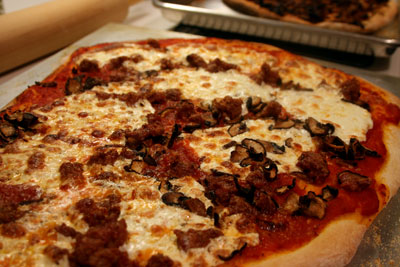
So, my mom's been wanting to make pizza for a long time now. The project seemed the perfect excuse, not that you need one: all things considered, it's a simple process and it yields great results even if you don't have a pizza stone, which *gasp* we do not. And it's really fun. And you can't argue with this:

Pizza.jpg

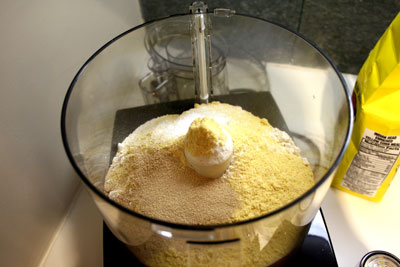
So you take flour, cornmeal (optional, but makes the crust crispier), yeast, and salt, and put them in the food processor.

Pizza3.jpg

Turn it on, and add some water and olive oil through the feed tube. It will form a ball within about thirty seconds; if it doesn't add some more water. What you end up with looks like this:

Pizza5.jpg

Put it on the floured counter. Knead it a little bit.

Pizza6.jpg

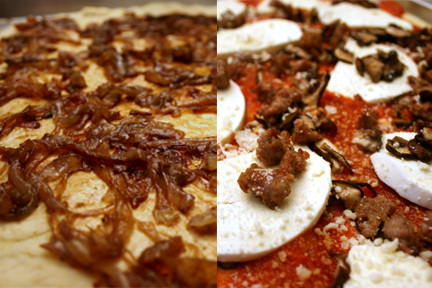
Put it in a bowl, cover it, and let it rise for 1-2 hours. Sounds like a lot of downtime, but this is when we threw together our toppings. Each batch of dough makes two pizzas (or one huge one, I guess). On one we did just some caramelized onions and balsamic vinegar. The other, tomato sauce, mozzarella, mushrooms and turkey sausage (from DiPaola Farms at the Greenmarket--the best turkey sausage I've ever tasted). So, we caramelized some onions, over fairly low heat, for a pretty long time til they were nice and brown and sweet and delicious. Did pretty much the same thing with the mushrooms, which cooked faster. Browned the sausage (crumbled out of its casing), and threw together a batch of Fast Tomato Sauce.

Pizza-Toppings.jpg

And by then, the pizza dough was ready.

We stretched and rolled it out so it was as thin as we could get it, then laid it out on the baking sheets and got to topping. For the white pie we mixed a bit of the balsamic vinegar with the onions and just spread them out on top. For the other pie, I spread out a pretty thin layer of sauce, then the cheese slices, then scattered about the sausage and mushrooms. Sprinkled some grated parmesan on top of that, because why not, and our pies were good to go.

Pizza8.jpg

Bittman says that they need to bake for 6-12 minutes on 500 degrees. Ours took more like 20 minutes, but maybe that's because we like a nice crispy crust. Here's the finished white pie:

Pizza2.jpg

This one is definitely going into heavy rotation; let me know if you ever want to have a pizza party and I'm so there.